

Local living
Outdoor Living in Port Charlotte, Florida
Patios, lanais and backyards are where a lot of everyday life happens here. This is a look at how the local climate shapes those spaces, and what makes them comfortable to use.
The community
A residential place on Florida’s Gulf Coast
Port Charlotte is a community in Charlotte County on Florida’s southwest Gulf Coast. Much of it is residential: neighborhoods of single-family homes, many of them single-story, laid out along streets and, in many areas, residential canals. You can read more about the community’s history and geography on Wikipedia’s Port Charlotte, Florida article, or explore the area on Google Maps.
For homeowners, the defining feature of daily life here is simple: it is warm and sunny for much of the year, and the outdoors is part of the house. Patios open off living rooms, lanais extend kitchens and family rooms, and many homes are designed so that the back of the house faces a yard, pool or waterway.
That makes outdoor space unusually valuable. It is also why the questions homeowners in Port Charlotte, FL ask most often are practical ones: how to keep the sun off a patio in the afternoon, how to cut glare on a lanai, and how to sit outside in the evening without insects.
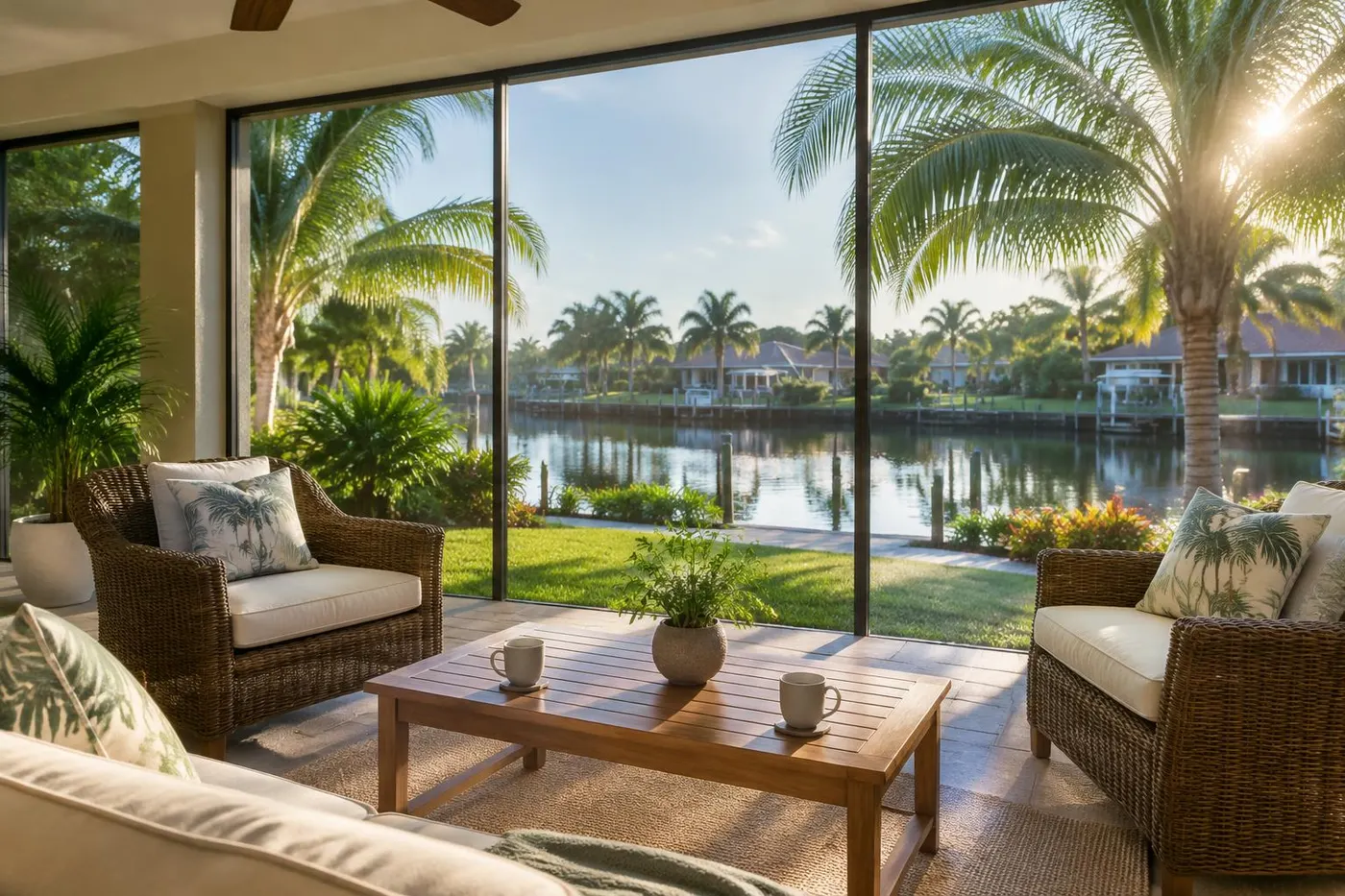
Lanais
The lanai: Florida’s extra room
Few features say “Florida home” like a lanai. Usually a covered or screened space attached to the house, it works as a sitting room, dining area and transition between indoors and the yard. Many are used every day: for breakfast, for reading, for watching the weather come in.
Because a lanai is open to the air, its comfort depends on what happens at its edges. Low-angle morning or late-afternoon sun can reach well inside, and the side facing west often becomes the hottest part of the home by late day. Screening on those open sides can help reduce sun and glare while keeping air moving.
Climate, day to day
What shapes comfort outdoors here
Sunshine
Strong sun is a constant companion through much of the year. A patio that is pleasant at 9 AM can be uncomfortable by 3 PM, depending on which way the house faces. Shade is often the difference between a space you use and one you only look at.
Heat and glare
Direct sun warms paving, furniture and the walls next to a patio, and it reflects off pools and light surfaces. Overhead shade and side screening both help, in different ways: one blocks sun from above, the other from the low angle.
Insects
Warm, humid evenings near water and landscaping bring mosquitoes and other insects. This is one of the main reasons so many local lanais are screened, and why homeowners look for screening that can be lowered when it matters most.
How residents use their space
Outdoor routines in a warm climate
Outdoor living here tends to follow the sun. Mornings are often the most comfortable time to sit outside, so many patios become breakfast spots. Midday, people retreat to whatever shade the house provides. Late afternoon and evening bring the patio back into use for dinner, grilling and time with family, as long as the western sun and the insects can be managed.
Pools add another dimension. A pool deck is wonderful for swimming but can be hard to sit beside without some shade. Homeowners frequently want a comfortable place right next to the water where they can watch children or relax between swims.
Entertaining matters too. Holidays, birthdays and visits from family often happen outside, and a covered, comfortable patio effectively adds space to the home for those occasions.
Patios
Making a patio usable through the day
Many patios here are open to the sky, or covered only by a short roof overhang. That works in the morning but not when the sun moves across. The practical answer for many homes is shade that can adapt: shade that is available when the sun is strong and can be put away when you would rather have open sky.
That flexibility is the appeal of retractable awnings, which extend over a patio when needed and retract against the house afterward. For seating and dining areas specifically, it helps to plan shade around the table and chairs you actually use, which is the focus of our page on patio awnings.
Screens
Screening the open sides
Overhead shade does not stop low sun or insects coming in from the side. That is where screens come in. Screens mounted on the open sides of a patio or lanai can be lowered in the late afternoon to cut sun and glare, or in the evening to help keep insects out, and raised again when you want the view.
Homeowners can choose manual or motorized operation, depending on how often the screens will be used and how large the openings are. Our page on retractable screens explains how those options compare for patios and lanais.
Finding the balance
Airflow, views, shade and screening
Part of the appeal of outdoor living here is the openness: a breeze moving through the lanai, a clear view of the yard, pool or water. Every shade or screening choice affects that openness in some way, so the goal is rarely maximum coverage. It is the right amount of protection at the right time.
A fixed solution suits a spot that always needs shade. But many patios and lanais in Port Charlotte change throughout the day. The same space might want open views in the morning, overhead shade at midday and screening against low sun or insects in the evening. Products that can be adjusted let one space serve all of those moments instead of locking it into one.
It also helps to remember that views matter in both directions. Screens can soften glare and sun while still letting you see out, and when raised they leave the opening clear.
Choosing what fits
Start with how the space is used
The most useful way to choose between awnings and screens is to begin with how your household actually spends time outside. A few common situations:
An open patio used for dining
Overhead shade is usually the first priority, planned around the table and chairs rather than the whole slab. A retractable awning keeps the option of open sky on cooler days.
A lanai that gets hot late in the day
When the problem is low western sun coming in from the side, screens on that side often matter more than additional overhead cover.
Evenings outside, without insects
Screening that can be lowered in the evening helps keep the space usable after sunset, then raised to open things up again.
Shade that changes often
If you expect to adjust shade or screens several times a day, motorized awnings and motorized screens make that easy and are more likely to actually get used.
Planning
Before you decide
Orientation
Note which direction your patio or lanai faces and when direct sun reaches it. This often explains why one side is so much warmer than another.
Openings and doors
Doors, sliders and windows affect where shade can be mounted and how people move through the space.
Everyday use
Think about the times you most want to be outside, not just the hottest part of the day.
Operation
Decide whether manual or motorized operation feels right for how often you will adjust things.
Thinking about your own outdoor space
If you live in Port Charlotte, a useful first step is to watch your patio or lanai for a day. Note when the sun reaches the spots you use, which side gets the most glare, and when insects become a problem. Those observations make any conversation about shade or screening far more productive.
Every home is different. Orientation, roof lines, doors and windows, and how the space connects to the yard all affect what makes sense. There is no single right answer, only the option that suits how your household lives outside.
PC Awnings is a local company that helps homeowners with exactly these questions. You can learn more about our services on the PC Awnings homepage, or call 941-395-0548 to talk through your space.